



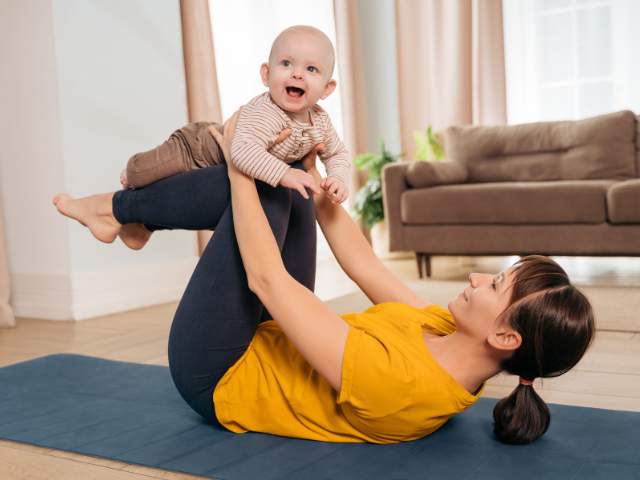
Many people believe that rehab after a Caesarean section isn’t as important as after a vaginal delivery, as the baby didn’t travel through the birth canal. But rebuilding both the core and the pelvic floor is important.
Why a Caesarean still affects your core and pelvic floor
- Pregnancy itself stretches and loads the pelvic floor and abdominal wall over nine months, independent of birth mode.
- The caesarean incision passes through several abdominal layers, and nerve pathways in the area are temporarily disrupted.
- Many women notice their deep abdominals feel disconnected or “not working” for weeks or months after surgery, which can show up as low back or pelvic girdle discomfort.
When to start rehab after Caesarean
- Breathing and pelvic floor exercises can be started in the very first days, as comfort allows.
- Core strengthening requires more care – some simple activation of the lower abdominals eg in sitting, is fine. But hold off more vigorous core work until the wound and deeper layers are healing well.
- A pelvic health physiotherapy assessment around this time is the best way to check how your deep core and pelvic floor are actually functioning, rather than guessing from symptoms alone.
Getting reconnected: the first steps
Early rehab after Caesarean is about coordination, not effort. This includes:
- Diaphragmatic breathing – the diaphragm and pelvic floor move together with each breath. Slow, low breaths gently begin to restore this coordination.
- Gentle pelvic floor activation – low level contractions focusing on smooth coordination, building up to maximum squeeze over time.
- Transverse abdominis activation – a subtle, low-level abdominal “hollowing” performed lying down, without holding the breath or bracing through the back.
- Walking – short, frequent walks support circulation and a gradual return of function without overloading the healing tissue.
Safely progressing rehab after Caesarean – from six weeks
- Over the first 6 weeks, simple core exercises eg heel slides, bridges can be started. Exercises such as modified side planks, crunches and bird-dog variations, can be started after six weeks, as pain allows
- Progression should be guided by how the tissue responds, not by a calendar date – everyone’s timeline looks a little different.
- Return to running, heavy lifting or high-impact exercise usually sits further along this progression, once the deep core and pelvic floor can manage load and pressure well.
What about diastasis recti?
- Diastasis recti refers to the stretching of the connective tissue (linea alba) between the two sides of the rectus abdominis. It is a normal, expected part of pregnancy for almost everyone, not just after caesarean birth.
- For many women the gap narrows in the months after birth, but the more useful marker is how well the midline manages tension and pressure, not the gap measurement alone.
- Rehab focuses on restoring tension and control through the midline. This is done with deep core coordination, posture and pressure management – rather than focussing on “closing the gap.”
Signs to get some extra support for rehab after Caesarean
- Ongoing doming or bulging through the midline with effort
- Leaking urine, or a strong, sudden urge to go to the toilet
- A dragging / heavy feeling, or bulging around the vagina
- Persistent lower back, hip or pelvic girdle discomfort
- Scar pain, tightness or numbness that isn’t settling
None of these are things to just push through – a pelvic health physiotherapist can assess what’s happening and build a plan around it.
How soon after a caesarean can I start exercising?
Gentle breathing and short walks can usually begin within the first days, as comfort allows. Structured core and pelvic floor strengthening typically waits until after six weeks.
Do I still need pelvic floor physio if I had a caesarean?
Yes. Pregnancy itself loads the pelvic floor for nine months regardless of birth mode, and many women benefit from a pelvic health assessment to check core and pelvic floor function is recovering well. Some people find their pelvic floor tightens after a Caesarean, and the treatment for this is different.
Will my diastasis recti go away on its own?
For many women the gap narrows naturally in the months after birth. But a tailored rehab programme helps manage tension and load , not just the size of the gap.
Is it safe to do crunches or sit-ups after a caesarean?
Not in the early recovery stage. Traditional crunches load the midline in a way that can work against healing; gentler, layered exercises that build control first are the safer starting point. Crunches and other abdominal rehab exercises can be added later.
Ready to get your core and pelvic floor working well again?
Book an assessment with our team to get a recovery plan tailored to you and your birth.
Also in this series
See our blog on Scar massage and desensitisation after a caesarean
Further Information
Find out more about Caesarean section and recovery
